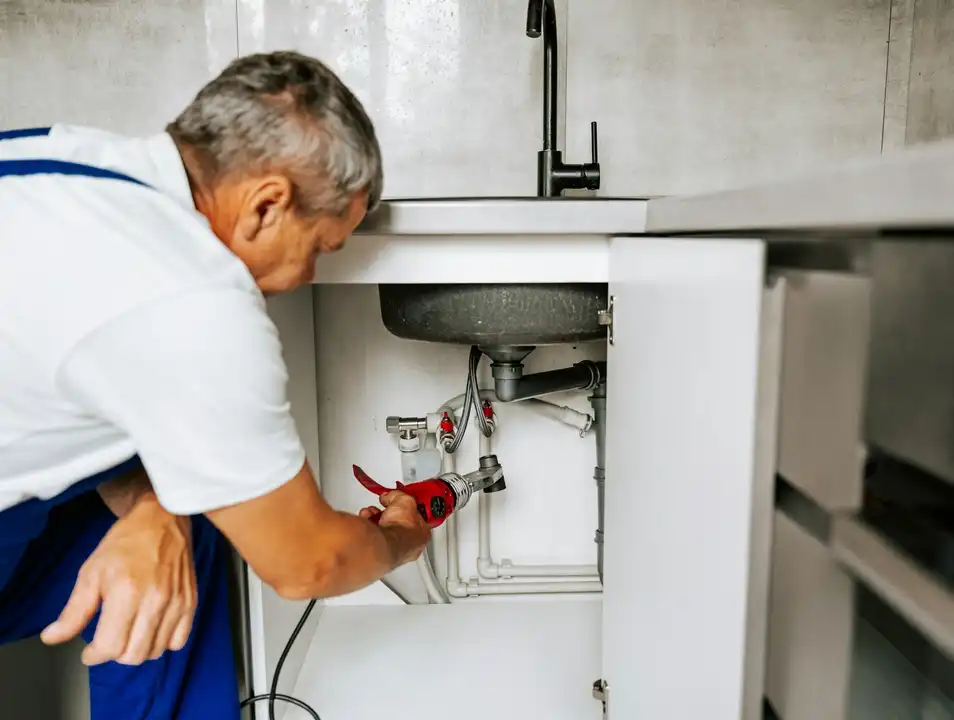
Why Hire a Plumber When My Uncle Can DIY It?
Every family has one.
He owns a cordless drill, a suspicious number of buckets, and at least one tool nobody else is allowed to touch.
Your sink starts leaking and, before you can even think about calling a plumber, somebody says:
"Don't pay for that. My uncle can do it."
And sometimes?
Your uncle absolutely can do it.
Plumbing is not magic. A clogged aerator does not require a four-year degree. Neither does replacing a toilet flapper, swapping out a showerhead, or tightening something that is obviously loose.
The problem begins when Uncle DIY reaches the point where he stops knowing what he is doing but does not stop doing it.
That is when a $40 repair can become a $400 repair.
Or a $4,000 repair.
Water is very committed to making mistakes expensive.
To Be Fair, Your Uncle Might Be Great at This
We are not here to insult your uncle.
He might be a retired contractor.
He might have remodeled six houses.
He might genuinely know more about residential plumbing than half the people giving advice on the internet.
If that is the case, hand the man a wrench.
The real question is not:
"Is he a plumber?"
It is:
"Does he actually know how to do this particular job?"
There is a significant difference between somebody who has replaced twenty toilets and somebody who watched a nine-minute video titled:
TOILET INSTALL EASY!!! YOU'VE BEEN DOING IT WRONG
Those two men may approach the project with equal confidence.
They should not receive equal trust.
Some DIY Plumbing Is Completely Reasonable
There are plenty of things homeowners can sometimes tackle themselves, depending on their comfort level and experience.
Those might include:
- Cleaning a faucet aerator
- Replacing a showerhead
- Changing a toilet flapper
- Using a plunger
- Cleaning hair out of a drain
- Replacing a basic faucet cartridge
- Tightening a loose fixture
- Swapping a simple fixture when the existing connections are in good condition
If you understand the repair, know how to shut off the water, and know what "done correctly" should look like, you may be comfortable handling it yourself.
That does not mean a problem is too small to call us about.
If you would rather have Flynn Plumbing and Mechanical LLC handle it, we are happy to come out. A client's need does not become unimportant just because the repair looks simple.
Plumbing also has an awkward characteristic:
The difficulty of the repair and the consequences of screwing it up are not always related.
A fitting can take five minutes to install.
It can also leak inside a wall for six months.
The Most Dangerous Plumbing Repair Is the One That "Worked"
The dramatic failures are easy.
You turn the water back on.
Water sprays across the room.
Everybody starts yelling.
Someone finds the shutoff.
Congratulations. You know there is a problem.
The sneakier failures are worse.
You finish the repair.
You turn the water back on.
Nothing happens.
No drips.
No noises.
No immediate signs of disaster.
Uncle wipes his hands on his jeans and says:
"Told you."
Three weeks later, the downstairs ceiling develops a strange brown spot.
This is one reason professional plumbing is not simply about making water stop coming out of the wrong place.
A repair has to survive after everyone stops staring at it.
Water Does Not Respect Your Confidence
You can bluff your way through a lot of home projects.
Paint does not care.
Drywall can usually be patched.
A crooked cabinet door might irritate you, but it is unlikely to destroy the room beneath it.
Water is less forgiving.
A small leak can damage:
- Drywall
- Flooring
- Subfloor
- Cabinets
- Insulation
- Framing
- Trim
- Paint
- Anything unfortunate enough to be stored underneath it
This is why the sentence:
"It's only dripping a little"
does not make plumbers feel better.
A little water, given enough time, becomes a great deal of water.
Plumbing Problems Love Disguises
One of the easiest DIY mistakes is fixing the place where the symptom appears instead of fixing the problem.
There is water under the sink.
Obviously, the sink is leaking.
Except maybe it is not.
Water can travel along pipes, fittings, cabinetry, framing, and other surfaces before finally dripping somewhere visible.
The spot where you find the water is not necessarily the spot where the water escaped.
The same thing happens with drainage problems.
Your kitchen sink drains slowly.
You pour something down it.
It drains faster.
Victory.
Then it slows down again two weeks later.
Maybe the problem was never the first few feet of pipe.
Maybe the restriction is farther down the line.
Maybe the pipe has poor slope.
Maybe there is buildup.
Maybe another part of the drainage system is contributing.
The plumbing version of "make the symptom disappear" is not always the same as "fix it."
The Hardware Store Has an Adapter for Everything
This is both wonderful and terrifying.
Walk through the plumbing aisle long enough and you will find enough fittings to connect almost anything to almost anything.
That does not mean you should.
Homes can contain:
- Copper
- PEX
- PVC
- CPVC
- ABS
- Galvanized steel
- Cast iron
Sometimes several of them exist in the same house because three generations of homeowners have each added their own contribution.
There are correct ways to transition between materials.
There are also ways that involve four adapters, a heroic amount of thread tape, and the phrase:
"That ain't going anywhere."
That phrase has preceded many things going somewhere.
"Just Tighten It More" Is Not a Plumbing Philosophy
A connection is leaking.
What should we do?
Tighten it.
Still leaking?
Tighten it more.
Still leaking?
Get the bigger wrench.
This is roughly how a minor plumbing problem becomes a broken fitting.
Some connections require a particular seal.
Some require a gasket.
Some require thread sealant.
Some should not receive thread sealant at all.
Some fittings can be damaged by overtightening.
Some toilets can literally crack if mounting hardware is cranked down too hard.
There is a point where additional force stops being repair work and becomes demolition.
Toilets Are Simple Until They Aren't
A toilet looks like one big ceramic object with about six moving parts.
How hard could it be?
Often, not very.
Replacing a flapper is easy.
Replacing a fill valve is manageable.
Even replacing an entire toilet can be straightforward when everything underneath it is in good condition.
The words doing the heavy lifting there are:
when everything underneath it is in good condition.
If a toilet rocks, leaks around the base, smells strange, or keeps having problems after being reset, there may be an issue with:
- The wax ring
- The flange
- The mounting surface
- The drain connection
- The subfloor
Sometimes removing the toilet reveals that the toilet was never really the problem.
It was simply hiding the problem.
Very rude of it.
Older Houses Change the Rules Mid-Project
In a newer home, replacing a valve may be exactly that.
Replace valve.
Done.
In an older home, replacing a valve might begin like this:
- Turn the valve.
- Valve does not turn.
- Apply slightly more force.
- Valve begins leaking.
- Discover pipe behind valve is corroded.
- Shut off water to house.
- Discover main shutoff has also decided today is its retirement party.
- Call plumber.
Older plumbing has history.
Sometimes a great deal of history.
Corrosion, old repairs, outdated materials, mineral buildup, frozen fittings, and questionable modifications from 1987 can turn an easy repair into an archaeological dig.
That does not mean old plumbing cannot be worked on.
It means you should assume it may have opinions.
The Three-Trip Rule
Most DIY projects have a point where you should evaluate your life choices.
For plumbing, we propose the three-trip rule.
If you have gone to the hardware store three times for the same repair and still do not know exactly what you need, the universe may be communicating with you.
Trip one:
"I need a fitting."
Trip two:
"I bought the wrong fitting."
Trip three:
"So apparently these are different kinds of threads."
Trip four should probably be a plumber arriving at your house.
There is no shame in this.
Professional tradespeople have trucks full of parts precisely because plumbing has spent the last century inventing slightly different versions of everything.
YouTube Is Fantastic Until Your House Is Different
YouTube has probably saved homeowners billions of dollars.
You can learn an incredible amount from watching experienced people demonstrate repairs.
The problem is that the house in the video is not your house.
The video may show:
- Different piping material
- Different valves
- Different fittings
- Different code requirements
- Different fixture construction
- Different access
- A house built 40 years later than yours
The guy in the video also knows what he is looking at.
That is a bigger advantage than it seems.
Instruction becomes much less useful when you cannot tell whether your situation matches the one being demonstrated.
Drain Cleaner Is Not Holy Water
A drain is slow.
You buy chemical drain cleaner.
You pour it in.
Maybe the drain improves.
Maybe it does not.
Then somebody else tries another product.
Then someone snakes it.
Then the plumber arrives and gets to work on a drain that now contains mystery chemicals.
Repeatedly dumping chemicals into a drain is not a diagnostic strategy.
If the same drain keeps clogging, something is causing it.
That could be a localized blockage.
It could also involve:
- Heavy buildup
- A restriction farther down the pipe
- Damaged piping
- Root intrusion
- Improper slope
- A larger sewer issue
A drain that clogs once might need clearing.
A drain that clogs constantly needs an explanation.
"My Buddy Can Do It Cheaper"
Probably.
So can you.
The cheapest possible plumbing repair is generally the one where nobody involved expects to make money.
That does not make it the least expensive outcome.
If your buddy replaces a $100 component for pizza and beer and it works perfectly, congratulations.
Excellent deal.
If the repair fails and damages flooring, cabinets, or drywall, the accounting changes rather quickly.
Price matters.
So does the cost of being wrong.
When DIY Starts Getting Spicy
There is a point where a plumbing repair stops being a casual Saturday project.
Think very carefully before experimenting with:
- Pipes inside walls
- Main water lines
- Sewer lines
- Water heaters
- Gas piping
- Major drainage problems
- Burst pipes
- Significant corrosion
- Hidden leaks
- Plumbing relocation
- Work requiring permits or inspections
These are jobs where getting the diagnosis wrong can be every bit as expensive as getting the repair wrong.
If you do not know what the pipe does, where it goes, what it connects to, or what happens when you cut it, maybe do not cut it.
This advice has broad applicability.
The Plumber Is Not Just There to Turn the Wrench
This is probably the biggest misconception about hiring any skilled trade.
You see the plumber replace a valve in 20 minutes and think:
"I could have done that."
Maybe you could have.
What you did not see was the part where they knew:
- Which valve was bad
- Why it failed
- Which replacement to use
- Whether surrounding piping was healthy
- How much force the connection could take
- What else should be inspected
- How to test the repair afterward
Expertise has an annoying habit of making difficult things look easy.
Nobody watches a professional pianist and thinks the piano must be doing most of the work.
Plumbers do not receive the same courtesy.
So When Should You Actually Call a Plumber?
Whenever you want one.
A small repair is still a real repair, and not every homeowner wants to spend Saturday afternoon figuring out why a toilet keeps running or why a faucet will not stop dripping.
Professional service becomes especially valuable when:
- The same problem keeps coming back
- Multiple fixtures are affected
- Water is appearing somewhere it should absolutely not be
- You suspect a hidden leak
- A shutoff valve will not work
- Plumbing is heavily corroded
- The repair involves a main line
- Pipes need to be moved
- You are opening walls or floors
- You have reached hardware-store trip number three
- Your uncle says, "I've never seen one like this before"
That last one is particularly important.
Flynn Plumbing and Mechanical LLC can come out for the small stuff, the big stuff, and the stuff you simply do not want to deal with yourself.
No plumbing problem needs to pass some imaginary seriousness test before it deserves attention.
So, Why Hire a Plumber When Your Uncle Can DIY It?
You do not always have to.
Seriously.
If Uncle Mike has been fixing houses for 30 years and knows exactly what he is doing, let the man cook.
If you are replacing a showerhead, you may decide to handle it yourself.
Or you may decide you would rather call us and spend your afternoon doing literally anything else.
Both are reasonable.
The important difference is between:
"I know how to fix this."
and:
"How hard could it be?"
Plumbing has made an enormous amount of money from that second sentence.
DIY the things you understand if you want to.
Call us for the things you do not.
Call us for the things you could do but do not feel like doing.
And if the project currently involves three open YouTube videos, two shutoff valves that no longer shut off, a bucket filling faster than expected, and your uncle saying:
"Hand me the bigger wrench."
We would definitely make the call.